There are many differences between Sunday’s London marathon and the one run in Boston, Massachusetts last Monday, not least the weather. While Boston’s runners struggled in wintry conditions, London’s race is predicted to be the hottest since the event began in 1981. Hopes that the Kenyan favourite, Eliud Kipchoge […]
But perhaps the most symbolic difference between the two races is also the most subtle. There was no runner wearing No 261 at Boston on Monday. The reason? Ask the person wearing that number at London.
Kathrine Switzer, 71, may not be a name familiar to the wider UK public, but among the running community she is considered marathon royalty.
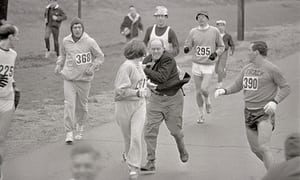
For it was Switzer who in 1967 became the first woman to run Boston as a registered entrant. It seems extraordinary today, but 50 years ago women were not allowed to compete in the world’s oldest annual marathon.
True, some had run the race unofficially before, but Switzer’s participation was to change everything, even if she did not realise its significance when, wearing an official bib, No 261, she lined up surrounded by hundreds of men for the start of the race.
“I had no intention of making history that day,” she said. “I was a kid who wanted to run. I signed up to the race. I signed my name K Switzer – I’d done it since I was 12 – and they thought I was a guy. I wasn’t trying to defraud them but my coach insisted that I officially sign up. He said: ‘You don’t mess around with Boston, you don’t just jump in the race.’ Other women had run marathons, and even one at Boston the year before, but not officially. We checked the rule book. Nothing in the rule book about it being for men only. It was only a tradition. They just assumed a woman couldn’t or wouldn’t want to run. Even on the entry form there was nothing about gender.”
What happened next has entered the annals of marathon history. Four miles into the race, an official, Jock Semple, attempted to grab Switzer, yelling, “get the hell out of my race and give me those numbers”.
Switzer remembers the moment graphically. “My coach was screaming at him, saying ‘She’s OK, leave her alone, I’ve trained her’, but he [Semple] was tired, and he was a man of his time. He didn’t think women should be there.”
Switzer’s boyfriend Tom Miller, a 17-stone ex-All American football player, who was also running the race, bodychecked Semple, knocking him into the air, a moment caught in photographs that went around the world. Switzer went on to finish in 4 hours 20 minutes, almost an hour after the first unregistered woman to finish, Bobbi Gibb.
Woman who blazed a trail for equality in marathons hits London’s starting line

From Madonna to Janelle Monáe: how female sexuality progressed in pop
Why Janelle Monáe’s vagina pants make me cheer | Chitra Ramaswamy
In 1997, Aerosmith released an ode to the female anatomy, simply titled Pink, in which Steven Tyler famously brayed about his tremendous love of a woman’s vagina. Every line began with the declaration “Piiiink…”, followed by a cheeseball rhyme scheme describing a variety of sexual situations. Subtle it was not.
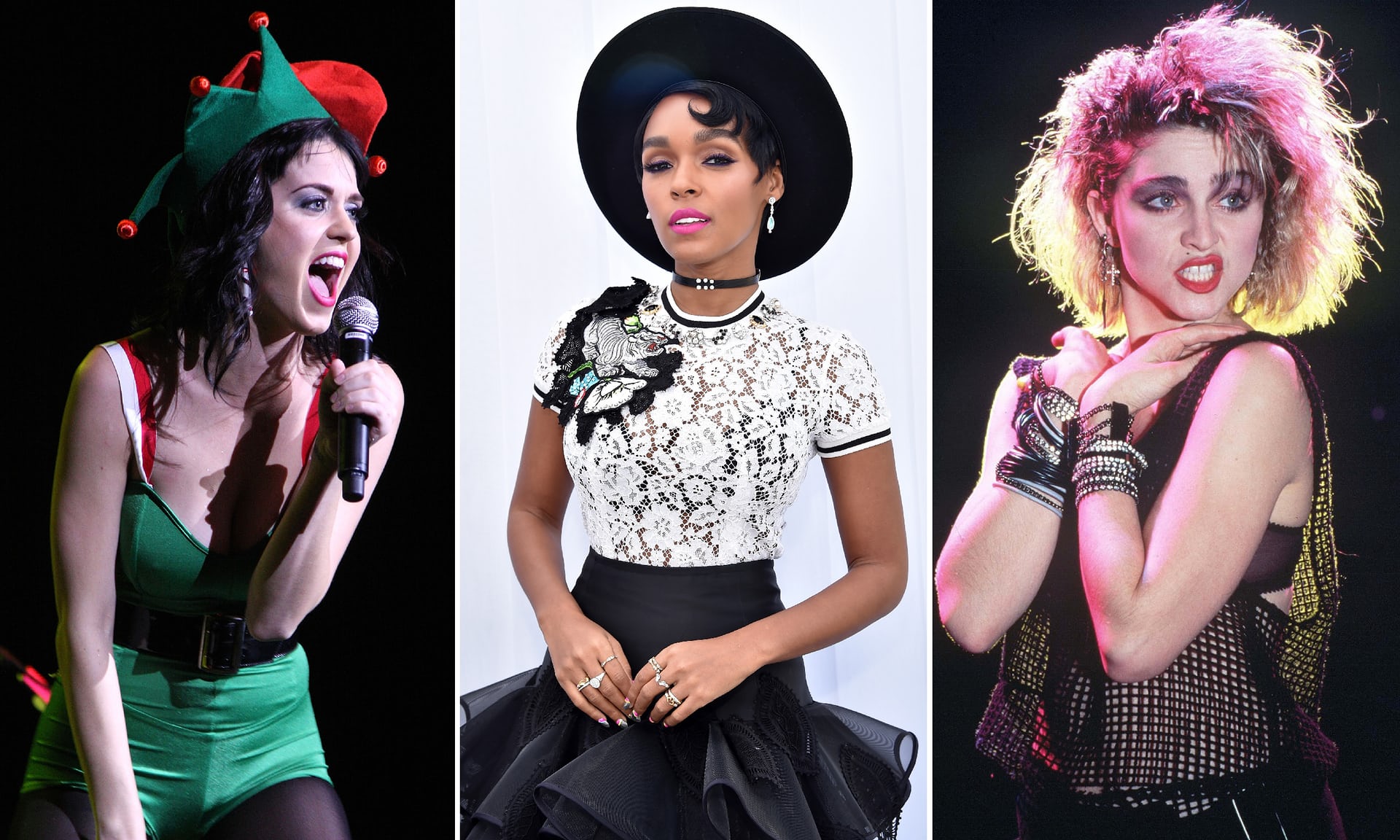
Fortunately, more than two decades later, R&B-soul luminary Janelle Monáe has rescued us from a lifetime of negative Aerosmith-word associations by taking back the song title, teaming up with art-pop nymph Grimes and swapping out the I for a Y. In 2018, we get Pynk, a silky, joyful, funk-fused gem that, like the Aerosmith track, is about the vagina and also starts each line with the word “pink”. But where Tyler was blunt and blundering, Monáe is slick and sophisticated.
Like the alternative spelling of “womyn”, Pynk finds Monáe keen to explore a world free from male influence. In the song’s vibrant music video, the star, who has never officially defined her sexuality except to deem herself “sexually liberated”, dances in triangular, ruffled “pussy” pants, throws a ladies-only house party, shows off unshaven pubic hair and nuzzles actor Tessa Thompson. She praises the female form and the nirvana between her legs (“Pink like the paradise found”). Men don’t figure into the song’s equation, unless it’s to dismissively point out that they’ve “got blue”. Which is fine, because “we’ve got the pink”.
Critics have hailed the song as a must-hear girl power anthem, while the lesbian community has praised its accompanying video for beingdeeply erotic and artistically groundbreaking.
Celebrating female sexuality in pop music is nothing new, of course. But has it ever been this For Women’s Eyes Only?
Madonna set a new bar for mainstream erotic expression in the early 80s when she famously humped the 1986 VMA stage in white lace, singing about how she’d found a lover so good that it made her feel like – well, you remember. In the next decade, she morphed from a newly liberated “virgin” to a proud dominatrix, publicly experimenting with then-taboo subjects like sadomasochism and BDSM on her fifth studio album, Erotica, and her carnal-noir 1992 coffee-table book, Sex.
Later, in the pop music boom of the late 90s and early 00s, legions of stars and would-be stars followed in Madonna’s stead, though they arguably took the “sexy virgin” thing a lot more literally than their 80s idol. In 1999, a teenage Britney Spears popularized short schoolgirl skirts and pigtails with her debut video for … Baby One More Time and posed for the cover of Rolling Stone in skimpy PJs with a plush Teletubby in one hand and a phone receiver in the other.
On her third album, though, a now twentysomething Spears showed off her sexually empowered side, opting for breathy, moaning vocals on 2001 single I’m A Slave 4 U and open-mouth kissing Madonna herself in 2003 at the VMAs alongside another newly “dirrty” pop performer (and fellow Disney Mouseketeer) Christina Aguilera.
Eight feminist ways to love your body

“I always end up feeling like shit when I look at Instagram,” said Selena Gomez , who has 133 million Instagram followers, when she was interviewed by Vogue last year. Selena. Freakin’. Gomez.
Of course, she’s not the only one. In 2017, the UK’s Royal Society for Public Health released a survey of 1,479 young people analysed on their attitudes to social media and found that Instagram, where personal photos take centre stage, received the worst scores for body image and anxiety.
“Instagram easily makes girls and women feel as if their bodies aren’t good enough,” admitted a respondent.
But blaming social media for women’s poor body image is easy. Harder to face is that Instagram is just the latest platform for the insidious syndrome of relentless body-hating our culture encourages in women. On this subject, a Glosswitch piece in the New Statesman exhorted feminists to remember the analysis in older tracts like Susie Orbach’s Fat is a Feminist Issue and Naomi Wolf’s The Beauty Myth, that “oppression was structural and bodies were real.”
“Once upon a time, we may have been angry about this,” she despaired.
Is feminism failing in the fight for the female body? The $160bn global beauty industry is growing at up to 7% a year, more than twice the rate of the developed world’s GDP.
My own belief is that it’s hard to escape a cage with a shape that keeps changing. Feminism may have accepted Naomi Wolf’s 1990 dictum that “dieting is the most potent political sedative in women’s history” but in 2018 #cleaneating” and #fitspo don’t admit to being diet cults, even 37m or 54m Instagram posts later. In her latest book, Natural Causes, Barbara Ehrenrich criticises the recent paradigm shift in which “now, health is indistinguishable from virtue”. The last decade has witnessed the emergence of orthorexia – an eating disorder in which a fixation for “healthy eating” is what causes one harm.
In the loops: the female producers making hip-hop waves
As per the Tribe Called Quest album, hip-hop is about beats, rhymes and life. The first of these can often get overlooked in favour of the second, but production is an essential part of the genre’s appeal. A slick production has the power to drive the lyrical message home: from the 80s, when Audio Two dropped their Daddy-O-produced classic Top Billin’; to 2001, when Dr Dre laced Still D.R.E with his signature aesthetic; to the twisted work of Hit-Boy for stars of this decade such as Kendrick Lamar and Kanye West.
One thing remains clear: production skews heavily towards men. Recent darlings include Mike Will Made-It, Murda Beatz, London on da Track, DJ Mustard – the list goes on. But as hip-hop evolves, more and more women are entering the production game.
The gender ratio isn’t yet equal, but far more women are getting production credits than when LA producer Georgia Anne Muldrow, 34, came on the scene in the early 00s. “At that time, there weren’t any other female producers in my social circle. But there were awesome female MCs,” she says. “You had Rah Digga, Digable Planets’ Ladybug Mecca, Missy Elliot. But I wasn’t hooked up with them – everyone was just kind of doing their own thing. The idea was just to be dope and get your stuff heard.”
Now, with female producers proliferating, women are expecting rather more than just getting heard – they can end up working with some of the genre’s biggest stars. Some gaining clout include Ebony “WondaGurl” Oshunrinde, who at just 21 has already made tracks for Drake, Travis Scott, Jay-Z and Rihanna, and the Virginia-based producer Shakari “Trakgirl” Boles, who has been in the studio with Omarion, Luke James and Jhené Aiko. She says that being a woman is no longer an impediment to getting ahead in the rap game. “The issue that I’ve had is something that happens in general: being undervalued and underappreciated,” says Boles. “That’s the same in any industry. But I would say it was a disadvantage being a woman in the beginning. I was underestimated. I’ve learned to build an armour when it comes to that.”
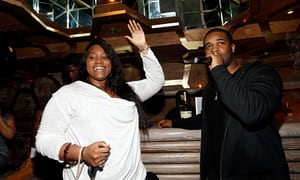
“I’m not offered some opportunities, I think, just because I am a woman,” says Harlem’s Crystal Caines (above), a producer since 2014. “I can’t assume, but … those opportunities are present, and yet they will give them to men over me.” But she sees the situation improving. “I was acknowledged as a producer first – now, I’m able to introduce myself as an artist, a producer and an engineer.” Caines, 26, is known for her haunting, slowed-down sound, which can be heard on tracks by artists such as A$AP Ferg, Smoke DZA and female rapper Bbymutha. “I just love making the artist uncomfortable sonically – that’s when they get the best product from me.”
Grace Nicol
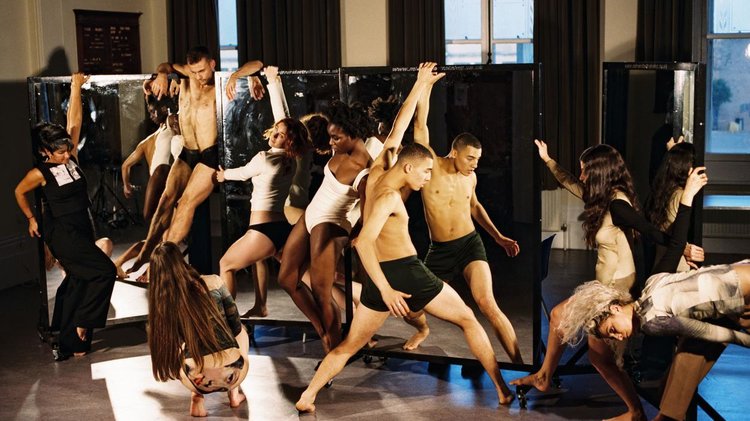
“The way that Grace chooses to work with materiality in relation to the body reminds us of the happenings of early feminist approaches to performance art. But somehow it also dives into the current complex debates on the labour of the performer as well as the stretching of duration […]

Seeing Hillary Clinton reminded me why women shouldn’t get over it

Seeing Hillary Clinton reminded me why women shouldn’t get over it
This week, I got to see Hillary Clinton speak to a crowd of 600 women when she made an appearance at the women-only social club the Wing. It was strange to watch this brilliant, knowledgeable woman and know that she could have been our president right now. It was painful, actually. And I wasn’t the only one who felt it – women in the room were openly shedding tears as she spoke. Seeing her was a reminder to many, I think, that we’ve made so little progress that the world’s dumbest and most awful man could win the presidency over the world’s most qualified woman.
But somehow getting to listen to her talk in a room with only women also made me hopeful. So often women are told to keep quiet and get over it – even Clinton, who has been harangued by rightwing media and told to disappear even as they talk about her nearly every day. For a few minutes, we got to be sad together without anyone telling us to suck it up. By the time we left, though, we were angry and inspired – a far more dangerous combination for the right.
Glass half full
A rosy future: Nestlé launches pink KitKats with ruby chocolate


The chocolate coating is an Instagrammable lurid lipstick pink with the promise of a unique “intense fruity taste”.
UK consumers will next week be the first in Europe able to buy Nestlé’s four-finger KitKat, made with so-called ruby chocolate from specially selected cocoa beans.
KitKat is the first major brand in the UK to feature this innovative but “naturally coloured” new chocolate, made from ruby cocoa beans grown in the Ivory Coast, Ecuador and Brazil.
It was created by Swiss chocolatier Barry Callebaut – the world’s largest cocoa processor – which spent more than a decade unlocking and experimenting with the beans’ colours and flavours.
The flavour is described by the company as “a tension between berry-fruitiness and luscious smoothness” but no extra colours or flavours are added to create the pinky hue, which instead comes from a powder extracted during the processing. It is not as sweet as milk chocolate, according to its creators, with a lighter flavour instead.
Ruby chocolate – a fourth chocolate after traditional dark, milk and white – has been attracting huge interest from chocolate connoisseurs throughout the world since it was first revealed in September last year. It is claimed to be the first new natural colour for chocolate since Nestlé unveiled white chocolate more than 80 years ago.
The new KitKat was introduced earlier this year in Japan and Korea, where consumers are no strangers to unusual variations of the popular confectionery. In Japan the varieties on sale at any given time stretch to dozens, including purple sweet potato, edamame bean and wasabi. In the UK it will go on sale in branches of Tesco on 16 April.
The new KitKat was introduced earlier this year in Japan and Korea, where consumers are no strangers to unusual variations of the popular confectionery. In Japan the varieties on sale at any given time stretch to dozens, including purple sweet potato, edamame bean and wasabi. In the UK it will go on sale in branches of Tesco on 16 April.
“We know that a new type of KitKat is a really big deal and we are very excited to be able to offer a different type of chocolate for fans to try” said Alex Gonnella, marketing director for Nestlé’s UK confectionery business. “Ruby chocolate is a big innovation in confectionery and we are very proud that KitKat is the first major brand in the UK to feature this exciting new chocolate.”
Pablo Perversi, chief innovation, quality and sustainability officer at Barry Callebaut, said: “I am very pleased to see the result of our partnership with Nestlé – the iconic four-finger KitKat made with our ruby chocolate. Consumers across the world will be intrigued by the unique taste of this crispy delight.”
Following the UK launch, the product will go on sale across Europe and the US.
Click here to view original web page at www.theguardian.com
Think Gender Is Performance? You Have Judith Butler to Thank for That.
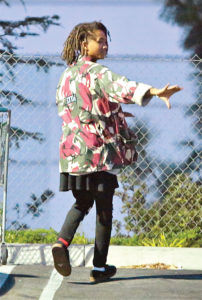 If you wanted to choose a celebrity avatar for everything supposedly weird about The Youth, you could do worse than Jaden Smith: a gnomic tweeter, sometime crystal devotee, self-described “Future of Music, Photography, and Filmmaking,” who has little attachment to the gender binary. Earlier this year, the 17-year-old son of Will Smith and Jada Pinkett Smith, brother of Willow, appeared in a Louis Vuitton womenswear campaign. Jaden Smith, quasar of contemporary teen behaviors, wears a fringed white top and an embellished, knee-length black skirt.
Wait, though. Rub your eyes, refocus your gaze, and really, is there any real reason why this ought to be weird? He looks good. And gender norms — they are pretty arbitrary, right? Smith also wore a dress, with a loose sport coat and sneakers, when he took The Hunger Games’ Amandla Stenberg to the prom. (Stenberg, meanwhile, recently came out as bisexual over Snapchat, though she’s also shrugged at conventional identity politics: “I don’t really see sexuality in boxes,” she has said.) Smith’s insouciant attitude toward gender looks less like affectation than evidence of a world that has changed profoundly in the two decades since his father starred on The Fresh Prince of Bel-Air. Or, for that matter, since his father refused to kiss a man onscreen 23 years ago.
Caitlyn Jenner’s coming out last year was a Kardashian-scale teachable moment — the opportunity for patient, prime-time explanations of why not to take gender for granted. But beyond the “transgender tipping point” heralded by Time and the broader awakening of identity politics, there is another revelation going on: a growing acceptance, especially among a broad swath of young people, of easy gender fluidity and ambiguity. In 2014, Facebook stopped limiting its gender options to male or female and began giving users some 50 other choices (from neutrois to genderqueer to cis). In 2015, the site abandoned that preset menu altogether and just let users enter up to ten terms of their own. We find ourselves poised someplace between gender mattering tremendously and mattering not very much at all.
The impulse to reexamine assumptions has had practical consequences — gender-neutral college dorms and high-school bathrooms — and cultural ripples. Writers like Jill Soloway (creator of TV’s Transparent) and Maggie Nelson (author of the queer-family memoir The Argonauts) have found human drama in gender’s mutability. Meanwhile, BuzzFeed offers an illustrated list showing “What People Say to Gender Nonbinary People vs. the Subtext We Often Hear,” and Rookie presents the recent comic “My Gender Is Weird.” Here’s Teen Vogue on another photo of Jaden Smith in a skirt suit: “The midi skirt set sends up a poignant rejection of heteronormativity.” What sage could have predicted that heteronormativity would eventually make its way into the vocabulary of teen magazines and shareable web content? Only, perhaps, the queer theorist Judith Butler.
Butler laughs when I tell her about the Teen Vogue verdict on Jaden Smith. “I think there aren’t very many of us who could have foreseen it,” Butler says, considering the blossoming mainstream interest in gender issues. We are speaking shortly after President Obama publicly voiced his support for transgender rights in the fight against North Carolina’s bathroom law, and gender — as something in need of definition, as something potentially ambiguous or complex — is at the center of national debate. “Such an utterance coming out of a U.S. president would be impossible in the 1990s,” Butler says.
Gender Trouble, published in 1990, made Butler a star: It introduced “performativity,” the idea that gender isn’t something we are but something we continually do, opening the door for “cultural configurations of sex and gender [to] proliferate,” as she put it in the book’s conclusion, “confounding the very binarism of sex, and exposing its fundamental unnaturalness.” If not for Butler’s work, “you wouldn’t have the version of genderqueer-ness that we now have,” says Jack Halberstam, a gender-studies professor at Columbia. “She made it clear that the body is not a stable foundation for gender expression.”
For much of her career, Butler was known mostly within academia, in part because of the difficulty of her prose. And yet the work Butler demands of readers is of a kind that, more than ever, they are willing to do now — if not necessarily while reading theoretical texts, then in moving through their daily lives. People outside the academy question their assumptions; they wrestle with unfamiliar ideas and examine their own discomfort. “Don’t laugh,” read a recent headline in the Washington Post. “I have a serious reason for raising my cats gender neutral.” (The reason: as a reminder to use the right pronouns for nonbinary friends.) Theoryspeak, meanwhile, has infiltrated civilian vocabularies. Trope and problematic and heteronormative; even, in a not-quite-Butlerian sense, performative — the sort of words that rankled queer theory’s culture-wars critics — are right at home on Tumblr and Twitter. In a broad-stroke, vastly simplified version, the understanding of gender that Gender Trouble suggests is not only recognizable; it is pop.
I was watching Scandal the other night,” Butler tells me, “and there was a great moment where a black character says, ‘Oh, race is just a social construct.’ ” She enjoys observing this kind of cultural cross-pollination. “I thought it was hilarious! It was a moment where an academic argument was brought into popular culture.” (Butler also watches Transparent, which she considers “enormously entertaining” but “much better on Jewish life than it is on trans life. It’s a little bit of a throwback to the La Cage aux Folles idea of transgender.”) This kind of thing happens with some frequency now, and often transcends mere hilarity, as when Laverne Cox talks in interviews about Simone de Beauvoir. “Laverne says, ‘It was that phrase, that one is not born but rather becomes a woman, that made it possible for me to think that I could become trans,’ ” Butler says. “You know, it’s kind of trippy that here’s this popular-culture person who has read and struggled with ideas, and went out into the world, and brought them with her” to reach new audiences.
“My mother’s generation, in their mid-80s, they’re having major debates about these issues,” she tells me. “It’s all on the table. And it’s all speakable.”
Gender Trouble hasn’t changed — chapters still feel like long-distance runs. And yet completing this feat of endurance today leaves the liberal-artsy reader with a curious sense of lightness. The feeling is not of your worldview’s being upended but rather thoroughly explained. That gender is not an essential biological fact: Sure. That it comes into being through repeated actions, so, like, I become recognizable as a “girl” by doing girl things: Okay. That the world as we know it has generally presumed everyone to be straight; that people who don’t play by the rules, gender-wise, straightness-wise, pay the price; and that, while maybe we can’t totally escape all of this, we can find ways of questioning it, possibly even undermining it, and so making life more livable for everybody: Yeah, sounds about right.
Alexandra Kleeman, a young novelist whose book You Too Can Have a Body Like Mine concerns femininity in all its elaborately constructed strangeness, told me about the day early in her first semester of graduate school at Berkeley (where Butler teaches) when she saw the professor sitting on a curb, talking on her phone. Butler was crouched down near the ground; she looked so small, said Kleeman, “and yet she contained all that theory.” In conversation, various Butler admirers and former students I spoke with tried to suggest her presence via celebrity comparison: Bob Dylan, Jon Stewart, Serena Williams. Like many famous people and not many academics, “Judith Butler” is both an exciting idea and an actual person.
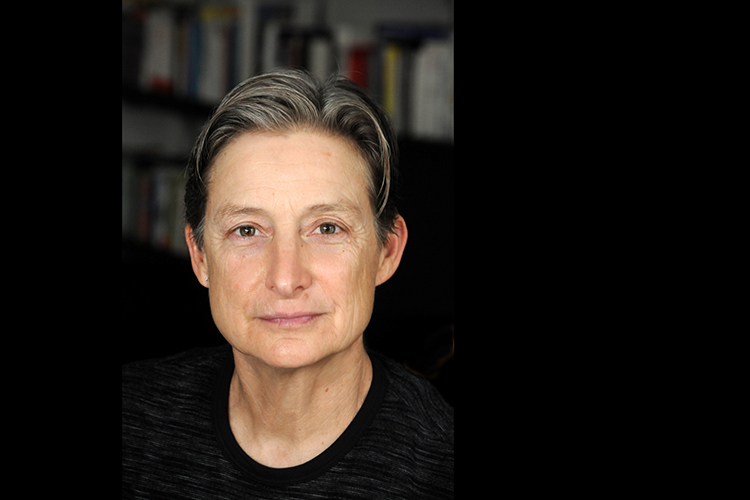
At 60, Butler has the lean, undeniable elegance of a cross-dressing Shakespearean heroine — a version of androgyny that has less to do with masculinity or femininity than with pants’ being expedient attire. Once, to her amused interest, a German newspaper described her as looking like “a young Italian man.” She wears a lot of black and gray. Her hair is short, side-parted, and falls forward a bit as she talks, requiring her to push it back with both hands.
Butler grew up in Cleveland, where her father was a dentist and her mother’s family owned movie theaters. When she was 12 or 13, a friend of her mother’s interviewed her as part of a teacher-training program. Asked for her dream job, the preteen Judith said she hoped to be a philosopher or a clown. This answer sounds either impossibly innocent or impossibly precocious; given that she was a middle-schooler who pestered her rabbi with questions about Martin Buber, probably the latter. Butler was an intense, focused reader. She was also gay, and so applying to colleges brought its own set of considerations. Butler went to Bennington because “it seemed to be a place where, as a young queer kid, I would be okay in 1974,” she says. “I knew that there were other people there who were at least minimally bisexual.” (Her parents, while not always wholly comfortable with her sexuality, were ultimately accepting. She remembers that her father was very happy when she came home from college with a Jewish girlfriend.)
After two years, she transferred to Yale for its philosophy program, where she remained through graduate school. Butler was active in New Haven and Yale women’s groups, and her time on campus coincided with the emergence of women’s studies as an academic discipline. She wrote her dissertation on Hegel and received a Ph.D. in philosophy.
With Gender Trouble, published when she was 33, Butler began articulating a theory of gender that fit into the Continental tradition she’d studied. The book drew on Foucault, Freud, Lévi-Strauss, Lacan, Irigaray, Wittig, Kristeva, and de Beauvoir. (Hegel, Derrida, and Nietzsche lurked in the background.) But Butler begins her analysis in a place that’s recognizably practical: How does “womanhood” get defined; on what assumptions does it depend? And, if a feminist movement defines itself as fighting for women’s rights, whose rights does it have in mind?
Halberstam, who was in grad school (and genderqueer) when Gender Trouble came out, remembers the book as a revelation, an escape from the “suffocation” of the era’s identity politics. “Academic feminism was riddled with problems at that time based upon these phrases like The personal is political that had led to people sort of sitting around in circles holding hands and telling each other about their lives,” Halberstam says. “Gender Trouble gave people a way of thinking critically, philosophically, abstractly about what it means to be in a political struggle where the category of womanhood, rather than holding together and cohering, might well be splintering and falling apart.” She and her fellow queer theorists were responding to forces already alive in the culture, Butler says, bringing an intellectual framework to bear on the efforts of activists.
In an essay (that began as a talk she gave at Yale in 1989, at the Conference on Homosexuality), Butler puzzled through what it meant to perform her particular identity category — to “theorize as a lesbian.” All such categories, “lesbian” included, could be “instruments of regulatory regimes, whether as the normalizing categories of oppressive structures or as the rallying points for a liberatory contestation of that very oppression.” It’s not that she rejected the label, she continued, but that she would like to remain “permanently troubled by identity categories.” In fact, she added, “if the category were to offer no trouble, it would cease to be interesting to me: It is precisely the pleasure produced by the instability of those categories which sustains the various erotic practices that make me a candidate for the category to begin with.”
Butler resisted attempts to pin her down, but she couldn’t avoid the flattening force of her reputation. In the early ’90s, a University of Iowa undergrad published a zine called Judy!; she called Butler “a bit Gap” but “still a fox.” Recognition beyond academia took longer. It wasn’t until 1998 that the New York Times explained the rise of queer theory to its readers, though the paper had cited Butler alongside Cornel West as examples of superstar professors the month before. (Butler’s first appearance in those pages was a letter to the editor in 1995: She took on the authors of an op-ed criticizing gangsta-rap lyrics by turning their Plato reference against them. “Whether it’s Sophocles or Snoop Doggy Dogg, the social distress they represent will not be eliminated by condemning the representation,” she wrote.)
By the late ’90s, Butler had the kind of entrenched status that attracts critics. For several years, the journal Philosophy and Literature ran a “Bad Writing” contest of academic prose. Butler earned the dubious honor in 1998 with this sentence:
The move from a structuralist account in which capital is understood to structure social relations in relatively homologous ways to a view of hegemony in which power relations are subject to repetition, convergence, and rearticulation brought the question of temporality into the thinking of structure, and marked a shift from a form of Althusserian theory that takes structural totalities as theoretical objects to one in which the insights into the contingent possibility of structure inaugurate a renewed conception of hegemony as bound up with the contingent sites and strategies of the rearticulation of power.
The following year, the philosopher Martha Nussbaum wrote a long takedown of Butler for The New Republic. Nussbaum took issue with her prose, which she called “exasperating”; she argued that it obscured derivative thought. Most significantly, though, Nussbaum disapproved of Butler’s version of feminism: In her view, Butler was ignoring the “material suffering of women who are hungry, illiterate, violated, beaten” in favor of focusing “narcissistically on personal self-presentation.” Butler’s work, she argued, amounted to an ineffectual, passive, “hip quietism”; “gays and lesbians do not achieve legal protection” through intellectual activity like Butler’s, she added, almost as an afterthought. The complaints of Butler’s critics back in the ’90s and today’s critics of campus p.c. culture share a skepticism at the power of words to shape the world.
In formulating her idea of gender performativity, Butler had drawn on the work of J. L. Austin, the philosopher of language who first proposed “performative utterances”: These are speech acts that don’t just describe reality but change it, like saying “I do” in a wedding ceremony. Her move was to apply this idea to actions as well as words. But as Austin pointed out, performative acts can still be “infelicitous” — saying “I do” doesn’t change things if the people saying it aren’t allowed to wed. There’s always the element of social context, a need for recognition and reciprocity. Paying attention to matters like pronouns “acknowledges and takes very, very seriously the idea that language matters,” Butler says.
“I always feel rude when I interrupt someone to say, ‘No, don’t call me that, that’s not okay,’ ” Butler tells me. “I feel like, Ugh, I’m the police, I’m patrolling everybody’s language. On the other hand, I don’t want to live with gender references that are really offensive to me.” A particular conundrum is getting addressed as a “lady” in restaurants. “It’s just like — Oh my God, I have not been in the struggle for this long to be called a ‘lady.’ Sometimes I’m with folks, born to various genders, who want to be a lady. For them it’s fabulous to be a lady. And I love ladies; don’t get me wrong,” she says. “I’m glad we live in a world in which there are ladies.”
In a small class, Butler asks students’ pronoun preferences; sometimes they care, sometimes they don’t. “It’s the most immediate, local way to make an intervention,” she says. “But it doesn’t exactly attack the foundations of transphobia or homophobia,” she continues, in a vein Nussbaum might appreciate. “I don’t think we can engage in the kind of linguistic idealism that would say that, ‘Oh, if we only change our language, we change the world.’ ”
At Berkeley, where she’s worked since 1993, Butler is in many ways surprisingly accessible for an academic celebrity. She shoulders a standard teaching load. This means that during the spring semester of 2016, for example, she could be found twice a week in a classroom with 50 undergraduates, leading a 100-level comp-lit lecture on “Dramas of Queer Kinship.” Butler is an easy performer, beckoning students to scoot their chairs forward. Watch her address a crowd and you become aware of how her writing is animated by her presence — if reading her work is strenuous, in person it’s Butler herself, and not her audience, expending energy.
Butler used to have an office alongside the rest of her colleagues in the comp-lit department, but the traffic she attracted eventually became oppressive. Now she works amid the art-history department: The Van Gogh postcard outside her office door is camouflage. Still, I pass a pair of students craning their necks. “That was Judith Butler who just went by us,” one says, “going into the bathroom!”
Butler came to Berkeley not long after Gender Trouble made her reputation. Part of the Bay Area’s appeal was the prospect of a comfortable place for her to have a family — somewhere to raise a child and have that child feel at home. Wendy Brown, Butler’s partner, is a political-science professor at Berkeley, and their son, Isaac, is now 21. “Once, when he was younger, I said, ‘So, how is it for you having queer parents?’ ” Butler remembers. “He said, ‘That’s not the hard part. The hard part is having two academics.’ ” Isaac has long curly hair and studies music at Wesleyan; in an interview he and his band gave as freshmen, he said his dream date was Beyoncé or Grace Kelly.
“Their feminism is much more clear than mine when I was their age,” says Butler of her son and his (mostly heterosexual) male friends. She had a conversation with a group of them not long ago about navigating campus sex in an ethical way. “For them, it wasn’t a sense that they needed to be a cop but that they needed to show up and exemplify a different kind of culture and be in conversation with other men who resist that.” These situations don’t always have to be a matter of policing behavior, she pointed out, with an academic’s idealism and a parent’s eye for positive reinforcement. “Like, Yes, I like to party; I like to dance; I like to have sex! But let’s think about the conditions under which that can work. It’s the basis of sexual ethics. What kind of community do we want to build?”
Isaac belongs to a generation for whom Butler is part of the canon. Today, it is possible to go online and read Judith Butler’s theory of gender performativity as explained with cats. There are Facebook pages like “Judith Butler Is My Homegirl.” Quotes from Gender Trouble are reliably reblogged on Tumblr. And yet, Maria Trumpler, director of Yale’s Office of LGBTQ Resources and a professor of women’s, gender, and sexuality studies, says that for the kids she sees at Yale today, 40 years after Butler was an undergraduate there, Gender Trouble is “really old-fashioned.” The last four years in particular have seen an enormous growth of student interest in identities “beyond the binary,” Trumpler says, like agender, bigender, genderqueer.
Butler is thrilled to see the work that has gone beyond hers. “I didn’t take on trans very well,” she says of Gender Trouble. The book doesn’t account for the experience of gender that someone like Caitlyn Jenner describes when she says her brain feels “much more female than it is male,” for example. “So, in many ways, it’s a very dated book,” Butler says. “And it’s one that wasn’t able to profit from the extraordinary scholarship that’s happened in that area in the intervening years.”
David Halperin was another early queer theorist and is the author, most recently, of How to Be Gay. He teaches at the University of Michigan. These days, he says, students learn Butler’s ideas “in courses on social justice, where everything is turned into a kind of sermon about what the proper political views are to have about minorities and equality, stigma, multiculturalism, and so on.” The ideas become “a series of political lessons,” often encountered second- or third-hand in other texts. Lara Sokoloff, a member of the Yale class of 2016, who did her thesis on gender politics, sees Butler as “very much this maternal figure in gender studies.”
“When we did all this back then, we were trying to find ways to say and think what had never been said or thought,” Halperin says. The shift from marginal to mainstream can be startling for academics who made their names as radicals.
Butler has begun to anticipate the freedom of her eventual retirement from Berkeley. (“Self-care is important, especially as you age,” she says; she goes to yoga twice a week and swims almost every day.) Retirement “deinstitutionalizes your work,” she explains. “It doesn’t diminish the amount of work.” Even as society has caught up to the questions she raised about gender, even if in some senses it’s surpassed her, she’s looking toward other, still-thorny issues. In recent years, Butler has been considering how we define the human. Whose lives do we see as valuable; whose deaths are therefore grievable? She’s written on post-9/11 “war on terror” rhetoric, Guantánamo, Israel, and police brutality. Difficulty, for Butler, often remains the point. But the possibility of things getting a little easier is one of the charms of this new world. A project she’s been talking about lately with the psychologist and writer Ken Corbett, a friend, is a new version of Gender Trouble — illustrated, for kids ages 8 to 12.
*This article appears in the June 13, 2016 issue of New York Magazine.
10 years of Lady Gaga: how she queered mainstream pop forever
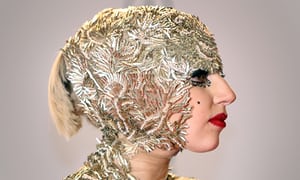

The year is 2008. I sit on the floor of my family’s modest living room in a sleepy suburb in Ireland, my tongue contorting around my teeth in concentration as I apply a finishing layer of glitter to my masterpiece. It is my 14th year of life and also the 14th time in an hour that I’ve hit the replay button on my big sister’s CD player. A mere month before this scene, Lady Gaga had exploded out of obscurity – it is her image my younger self is reproducing in card and glitter, while Just Dance, released 10 years ago this week, loops in the background.
In this moment, I already know that whatever is represented by this woman, this symbol, I love wholeheartedly. I know that she is the living embodiment of some ideal type that informs who I am. What I don’t yet know is that who I am is gay – and that my gayness will become inextricably intertwined over the course of my life with Gaga. She will become the background music in every gay club I will dance in, the overture to every drunken kiss, a talking point for every first date.
Female pop icons have long formed a core part of gay culture, and much has been written about why. Some say we live vicariously through their sexuality; more Freudian theories suggest they’re our surrogate mothers. Less controversially, one could simply say their bright pop ballads about overcoming love and loss have historically provided a light-hearted, strobe-lit, glittery escapism from a world darkened by the shadows of HIV and homophobia. Before Gaga there was Madonna, Cher, Diana Ross. You may think Gaga didn’t do anything over and above what these performers did: provide glamour and camp value. But the special place she carved in the hearts of gay people cannot be reduced to her penchant for changing wigs – Lady Gaga queered the mainstream.
She emerged into a pop landscape staggeringly different to the one we inhabit in 2018. The pre-Gaga charts of 2007 were socially and politically sterile, thronged with such hetero banalities as Kaiser Chiefs and Timbaland. The closest we got to queer representation was the tasteless gay-baiting of Katy Perry’s I Kissed a Girl in 2008. We were at the zenith of an economic boom, unaware of the impending global economic catastrophe that would spark a period of political revolution to coincide with Gaga’s rise. Economic comfort meant that oppression was felt less keenly, that discourse was relaxed. For kids like me stagnating in small towns, in countries where gay marriage was still illegal and casual homophobia rife, the silence felt like the calm before the storm.
Some would have disregarded the reactionary content of noughties charts and simply looked back to David Bowie, Prince and Boy George for revolutionary queer role models instead – they destabilised gender categories a decade before Gaga was born. But to my generation, these icons and their reassuring androgyny were out of reach. My childhood was an alienating cultural wasteland, where I survived on a diet of my parents’ Irish country music and my peers’ Top 40 pop. This was still the age of dial-up modems – for many pre-smartphone era queer kids, the likes of Bowie may as well not have existed.
Consequently, Lady Gaga turned my world upside down. I suffered from chronic anxiety, linked to years of bullying. I was offensively effeminate and school was an ordeal spent avoiding older boys who spat “faggot” at me in the corridors. After Gaga exploded, I fashioned my own diamond-encrusted glasses and dyed my hair green – the slurs in the corridors lost their power when, like Gaga, I was deliberately provoking the attention. “What a freak,” my peers would scream at pictures of Gaga’s meat dress. I burned with defiance to hear them deride her – if she was a freak, this person I loved, then I didn’t want to be normal any more. The word “faggot” resounding in the corridor no longer marked me out as lesser, but placed me on a pedestal alongside my heroine, another freak – who happened to be No 1 in 20 countries. Her otherness made my own otherness feel more aspirational than painful. In a world of utter darkness, her presence was my only light, a wordless pathway to myself before I even knew what the word queer meant.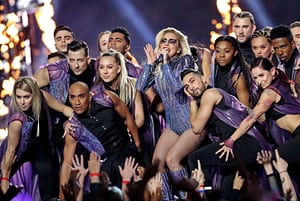
Gaga did for my generation what Bowie did 20 years earlier. She re-queered a mainstream that had fallen back into heteronormative mundanity. She vocally defended the rights of LGBT people and spoke of her own bisexuality openly. In pop, she expanded what was palatable. She repopularised the flamboyant theatricality of outrageous costuming, on-stage bleeding and compulsive wig changes. She drew inspiration from Bowie’s lightning bolts, Alexander McQueen’s fashion, Leigh Bowery’s performance art, Prince’s androgyny. She performed in male drag, and forced us to question gender characteristics and human physicality with facial protrusions and prosthetic penises. She was the vanguard for a revival of queerness in pop culture that has left an astonishing legacy a decade later – one would hardly bat an eyelid now to hear a word such as “transgender” uttered in a chart-topping song, but before Born This Way the thought would have been startling. It is partly thanks to her that we now live in an era where RuPaul’s Drag Race is mainstream.
In fact, Drag Race is perhaps the key to understanding what Gaga did for young queer people. When Gaga appeared as a host on the ninth series of the show, she entered posing as one of the contestants. It’s not insignificant that Gaga presented herself as a drag queen – that’s precisely what she has always been, and what she taught young queer people like me to be.
Drag is about borrowing cultural references to construct a persona. When Gaga reinvented the revolutionary queer spirit of Bowie and Prince for the youth of the noughties, she was performing a drag of her own. She borrowed tropes to construct the persona that accrued her fame, figuratively lip-syncing along to the legacies of Cher, Madonna, and the stars she imitated. She invented Gaga in the same way that drag queens do their alter egos.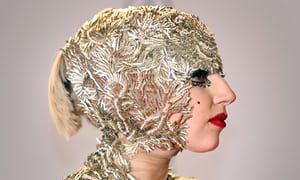
‘She taught a new generation of young queer people how to drag up an identity out of a barrenness around them’ … Lady Gaga in 2011. Photograph: Daniel Roland/AFP/Getty Images.
Millions of young gay people in turn used her example to construct their own identities in small, alienating towns and villages around the world. Every person needs references to inform their social performance, to do a sort of drag in their daily lives. Gaga offered queer people those references that our heteronormative hometowns couldn’t, reaching back into the past and passing them forward to those of us who could not access them alone. She taught a new generation of young queer people how to drag up an identity out of a barrenness around them, by looking to history and pop culture. This is what gay people have always done – but many of my generation didn’t know how. Mine was a generation whose would-be mentors had been decimated by the HIV epidemic, causing a wealth of generational community knowledge to be lost forever; a generation where cohesion in the real-world gay community was breaking down and gay spaces were closing.
Gaga replaced my would-be mentors. When I mimicked her outrageous presentation, I was tapping into the references she offered to express a queerness that I was not yet able to put into words. Without her in the charts, many queer kids like me would have been left with no touchstones whatsoever. She taught us all to be drag queens in our own lives – as RuPaul says, “We’re all born naked, the rest is drag”. When Gaga came to host Drag Race 9, she was truly coming home. Her importance was summarised with beautiful simplicity when one of the contestants, Eureka, broke down, saying “you don’t realise what you do for people like us”.
Ten years on, Gaga’s legacy is a changed world. For me, and many gay people around the globe, she is the icon of our generation, to whom we owe nothing less than our identities. Baby, there’s no other superstar.