
In the early 1990s, the accordionist and musical improviser Pauline Oliveros wrote the soundtrack for a feminist porn film called The Sluts and Goddesses Video Workshop. The film is presented and co-directed by Annie Sprinkle, a sex worker turned academic whose lecture covers everything from deep breathing and vaginal bling to STD prevention and “mega orgasms”. Along the way, we get a spectacular sonic counterpart of drones, glitches, bleeps, twangs and pulsations.
Conventional porn music this is not: no sultry saxophones, no oily bass guitars. Instead, Oliveros made sounds that are fun, tactile and inquisitive. If Sprinkle’s mission was to confront industry standards of what erotic looks like, freeing viewers to define their own tastes, Oliveros reminded us that the power to decide what music means should ultimately belong to the listener.
This autumn, in the wake of the allegations against Harvey Weinstein and others, a couple of things became urgently clear. We must listen more carefully to women’s voices, and we must change the power structures that govern much of public and private life, including the arts.
“Pauline was empowering her listeners,” says the writer Ione, the late Oliveros’s partner and regular collaborator. “Sluts and Goddesses was not pornography, not if you mean the word in any pejorative or sleazy sense. It was about sexual freedom, showing that sexuality is a natural and wonderful thing for women. The sounds Pauline made were deeply sensual because they related to the body. Her music was always about the Earth, the body, being human, the cosmos.”
The film gets a rare public screening this week at the London contemporary music festival, in a section termed (brace yourself) New Intimacy. Contemporary music has a long and tetchy history of labels, schools and isms, almost all coined by programmers or academics rather than artists themselves. New Intimacy seems a cheeky throwback to the contentiously named New Complexity and New Simplicity movements of the 1980s.
There is a particular irony to the “new” bit, given several of the works at LCMF are three or four decades old. But what about the “intimacy”? “Modernism was about removing the body from art,” says festival director Igor Toronyi-Lalic. “About removing personal identity and prioritising science, abstraction and objectivity. With postmodernism, the body is reinserted into feminist art, queer theory. That is what’s at the heart of the New Intimacy movement.”
The series includes a work by Kajsa Magnarsson “for strap-on and electric guitar”; a piece by Claudia Molitor to be performed by audience members within their own mouths as they chew sweets, popcorn and crisps; and the 1965 film Fuses, in which Carolee Schneemann documents the most intimate moments of her relationship with composer James Tenney. Also in the mix is the pristine and ultra-sparse Second String Quartet by Wandelweiser composer Jürg Frey – music so stripped back and delicate it can start to feel febrile, like the tender stuff left exposed after some kind of sonic disrobing. Aesthetically, it’s probably the diametric opposite to the sparkly dildos and nipple tassels of the film, but maybe the point is how these works share a potential to empower and turn the attention back on audiences.
Claudia Molitor has been exploring the haptic in music for nearly two decades, and welcomes the wide scope of New Intimacy. “It’s a provocation, right? Most of the time, women aren’t supposed to express ourselves in certain ways because it’s considered unbecoming, so maybe it’s good to put something out there that is unbecoming. If it makes people uncomfortable, that’s all right. A lot of women spend quite a lot of their lives feeling uncomfortable. Anyway, it’s hardly new. Mozart said it with Cosi Fan Tutte: women have the same desires as men.”
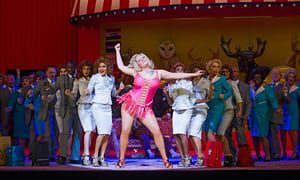
Composer and performance artist Jennifer Walshe likewise uses her work to deal with gender and identity. Her confrontational 2003 music theatre piece, XXX Live Nude Girls, featured Barbie dolls in all manner of sexual positions and scenarios of abuse. “If you want to privilege the female gaze,” she says, “you have to privilege it at every level of production, right down to technical crews. Think of an opera like Anna Nicole.” This was a work by Mark-Anthony Turnage, about the Playboy star Anna Nicole Smith. “The librettist is a man, the composer is a man, the director was a man. Why aren’t women allowed to write their own stories?”
Walshe also questions the potential in New Intimacy for exploitation or plain voyeurism. “Sometimes I feel that women are forced into a position where they are only permitted to have a voice by articulating their most intimate details,” she says. “Memoirs by musicians like Viv Albertine, Kim Gordon, Carrie Brownstein, Kristin Hersh – all of which are books I love – get very deep into the personal in a way many memoirs by male musicians don’t.